Shinobi Miniatures Set – 3D Printable STL Files for Japanese Wargaming
$15.00
Unleash the shadows upon your tabletop with our Shinobi Miniatures Set. These masters of espionage and silent combat are captured in stunning detail, embodying the fluid grace and deadly precision of legends from feudal Japan.
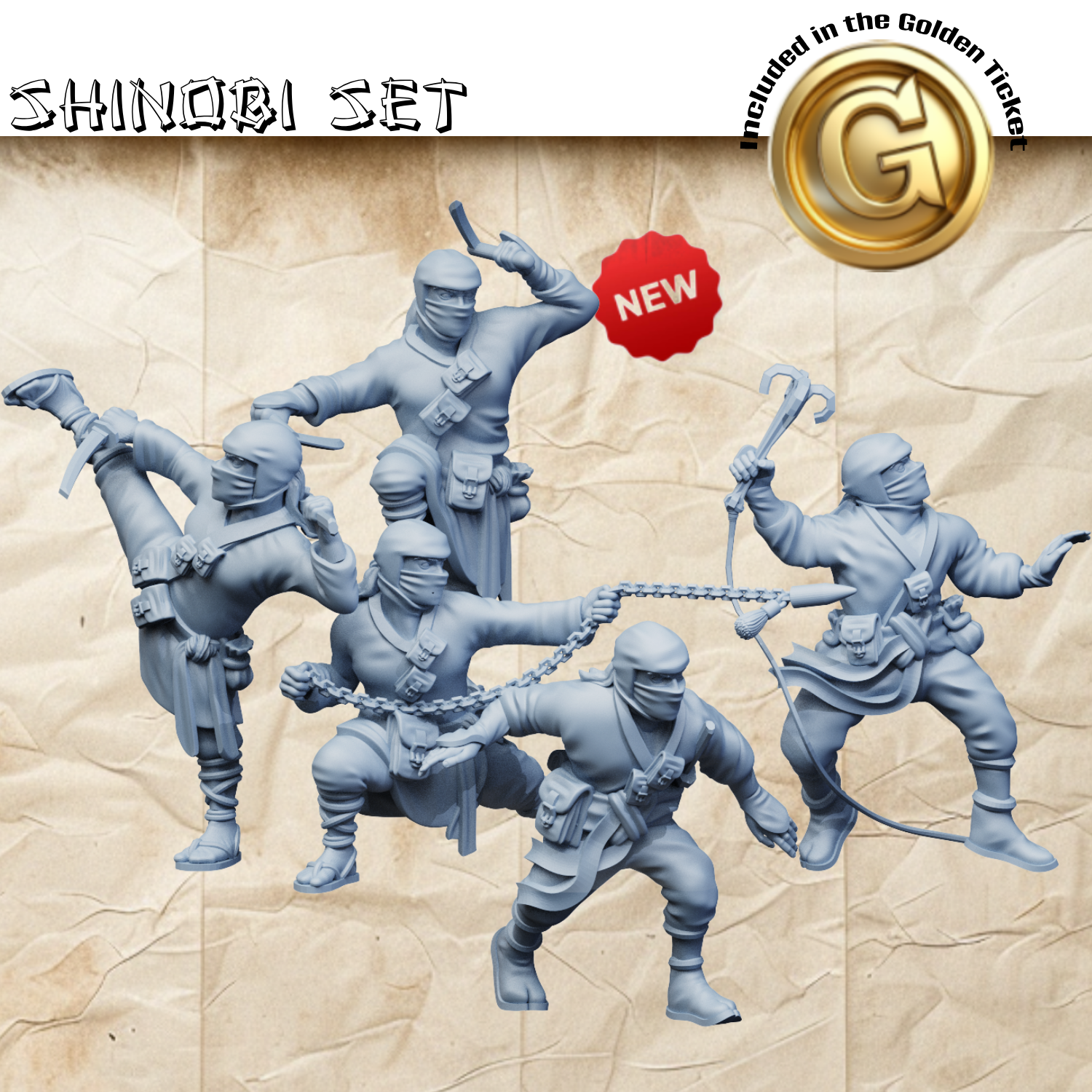
This collection features five unique warriors in dynamic, action-packed poses. Armed with iconic weapons, they are perfect for adding stealth, sabotage, and thrilling encounters to your RPG campaigns and wargames. Bring the art of the unseen to your game!
This set of digital STL files includes five masterfully sculpted Shinobi miniatures, each designed to bring a sense of deadly grace and dynamic action to your tabletop. The figures are scaled for 28mm and 32mm games, making them perfectly compatible with the most popular historical and fantasy wargaming systems. While optimized for the high-resolution detail of resin 3D printers, these models can also be printed on FDM machines with appropriate settings. The set showcases a variety of classic Shinobi tools, including the kusarigama (chain-sickle), kunai, and kaginawa (grappling hook), all rendered with crisp, printable textures from the fabric of their garments to the leather of their pouches.
On the battlefield, these miniatures serve as elite skirmishers, assassins, or objective-capturing units. In role-playing games, they are the perfect representation for player characters or formidable NPCs specializing in stealth, infiltration, and espionage, allowing you to visually narrate every silent takedown and daring escape.
The Historical Shinobi
The Shinobi, popularly known in the West as ninja, were covert agents and mercenaries in feudal Japan who specialized in unorthodox warfare. Their history is shrouded in mystery and folklore, but they were most active during the turbulent Sengoku period (15th–17th centuries), a time of constant civil war. Unlike the samurai, whose code of Bushido emphasized direct combat and honor, the shinobi operated from the shadows, prioritizing the mission’s success above all else. Their roles were diverse and included espionage, sabotage, infiltration, assassination, and guerrilla warfare.
Contrary to popular culture’s depiction of them clad exclusively in black, shinobi were masters of disguise. They would often pose as farmers, monks, merchants, or performers to gather intelligence or get close to a target without arousing suspicion. The iconic all-black ‘shinobi shōzoku’ was more likely adapted from Japanese theater, where stagehands dressed in black to signify their invisibility to the audience. In reality, a shinobi on a nighttime mission would wear dark, navy blue clothing to better blend with the night sky.
Their training, known as ninjutsu, was a comprehensive suite of survivalist skills. It encompassed not only martial arts (taijutsu) but also scouting, disguise, escape methods, medicine, explosives, and toxicology. They were experts in utilizing the terrain and were proficient with a wide array of specialized tools. This included the ‘kaginawa’ (grappling hook) for climbing, ‘mizu gumo’ (water spiders) for crossing water, and a variety of blades. Their arsenal included the versatile ‘kunai,’ a utility tool that could be used for prying or as a weapon, and the formidable ‘kusarigama,’ a sickle attached to a long chain with a weight at the end, capable of ensnaring opponents and their weapons from a distance. The legends of the shinobi from the Iga and Kōga provinces became particularly famous, solidifying their place in history as the ultimate practitioners of espionage and unconventional tactics.
Related products