
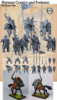
Early Roman Imperial Cavalry – 3D Printable STL Miniatures
$16.00
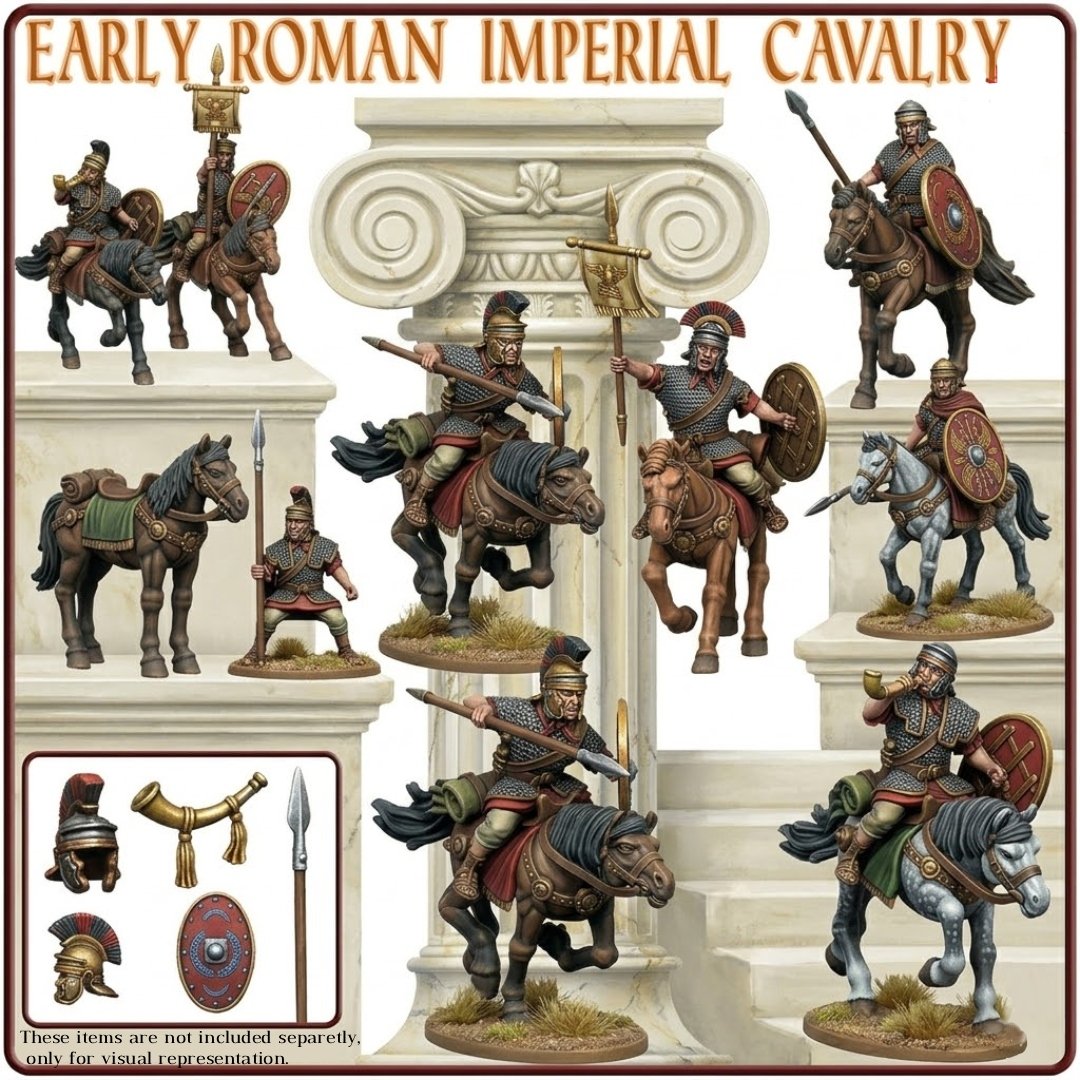
Unleash the might of Rome’s legendary cavalry on your tabletop! This meticulously detailed set captures the disciplined power of the Early Imperial era, featuring dynamic poses that bring your historical wargames to life.
From the charging standard-bearer to the rallying horn-blower, each miniature is a masterpiece of historical accuracy. Perfect for collectors and wargamers, these models will form the elite vanguard of your 3D printed Roman legion, ready to dominate the battlefield.
This digital product contains the STL files for a unit of five distinct Early Roman Imperial Cavalry miniatures. Expertly sculpted for 28mm and 32mm scale tabletop games, these models are optimized for stunning results on both Resin and FDM 3D printers. The set is delivered with 5 unique riders and 5 separate horses, allowing for customized posing and dynamic unit composition. The command group includes a Vexillarius (standard bearer), a Cornicen (horn-blower), and an officer, essential for representing leadership, morale, and command and control in your wargames. Two troopers armed with spears complete the unit, perfect for scouting, screening the main legionary force, and delivering a decisive charge.
Historical Context:
The cavalry of the Early Roman Empire (c. 27 BC – AD 284) marked a significant evolution from the Republic’s reliance on allied Italian and citizen horsemen. As the Empire expanded, its cavalry needs grew, leading to the large-scale recruitment of non-citizen auxiliaries from provinces renowned for their equestrian skills. Peoples such as the Gauls, Germans, Thracians, and Iberians formed the backbone of the Roman cavalry, organized into units called ‘alae’ (wings). An ala could be ‘quingenaria’ (nominally 500 strong) or ‘milliaria’ (1,000 strong) and was a formidable, flexible fighting force commanded by a Roman Prefect.
These auxiliary horsemen were not the heavily armored shock cavalry of later eras but served as the eyes and ears of the legions. Their primary roles were reconnaissance, screening the army’s flanks from enemy skirmishers, pursuing and cutting down routing enemies, and providing a fast-moving response force on the battlefield. While a frontal charge against a prepared infantry formation was a risky proposition, they excelled at harassing enemy flanks and exploiting breakthroughs.
Their equipment reflected their diverse origins and tactical role. The miniatures in this set are depicted wearing ‘lorica squamata’ (scale armor), which offered excellent protection and flexibility. Helmets were typically of the Imperial-Gallic type. Their primary offensive weapon was the ‘hasta’, a long thrusting spear, supplemented by the ‘spatha’, a longer sword than the legionary’s ‘gladius’, which provided better reach from horseback. For defense, they carried a flat oval or hexagonal shield, the ‘parma equestris’, which was lighter and less cumbersome than the legionary scutum. The famous four-horned Roman saddle provided exceptional stability, allowing the rider to deliver powerful spear thrusts even without the use of stirrups, which had not yet been introduced to Europe. This set of miniatures brings that storied history directly to your gaming table, allowing you to recreate the swift and decisive power of Rome’s auxiliary cavalry.